1. Set out
The rig is positioned at the pile location and the pile centre and level are checked.
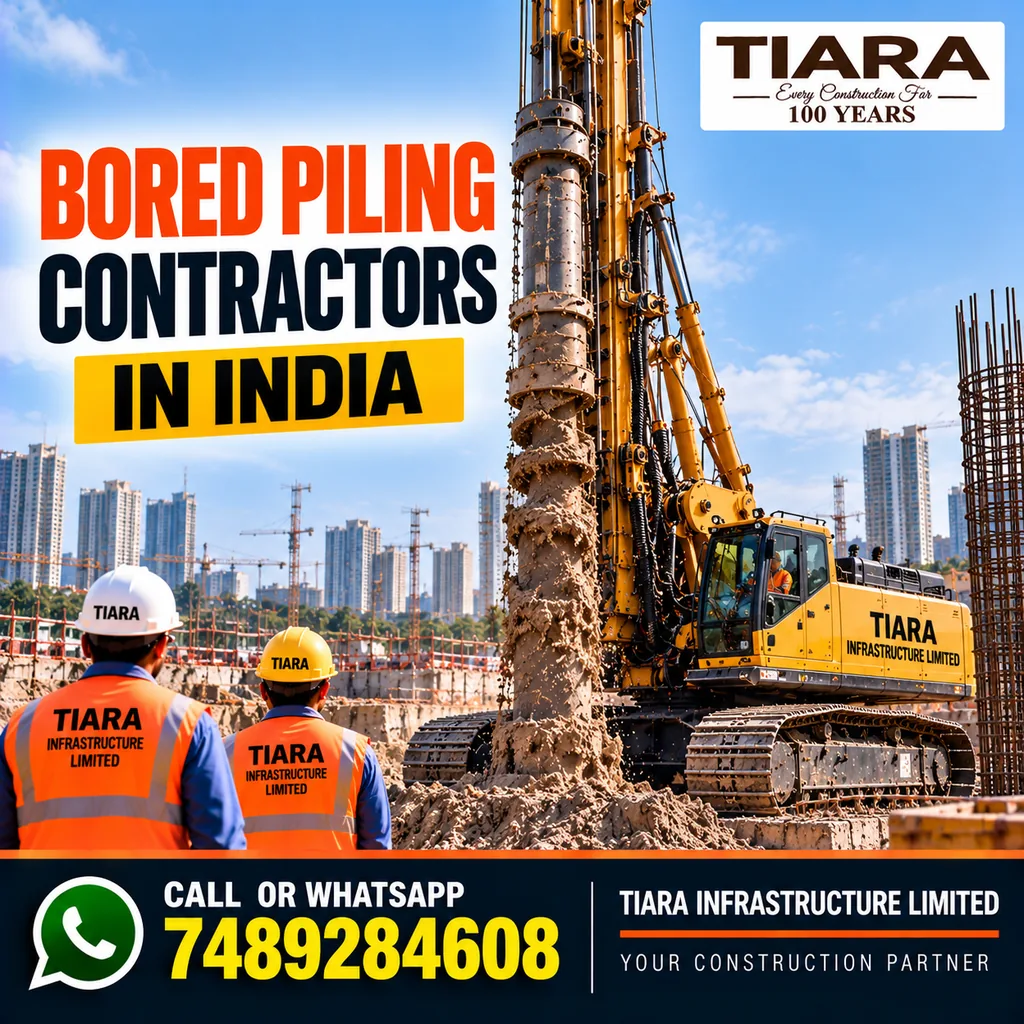
India's ground ranges from soft river alluvium and delta clay to granite, basalt and laterite rock. Heavy structures on that ground need deep foundations that reach firm strata, and bored piling is one of the most widely used ways to build them. A hydraulic rotary rig drills the pile hole with little vibration, a reinforcement cage is lowered in, and concrete is poured to form the pile.
As one of the bored piling contractors in India, Tiara Infrastructure Ltd. carries out bored piling works in India and supplies hydraulic bored piling services in India for contractors, developers, industries and public agencies. This page explains what bored piling is, when it is used, how we work and the requirements across states and project locations.
Tiara Infrastructure Ltd. provides hydraulic bored piling services in India. We drill and cast bored piles for bridges, buildings, industrial plants, ports and retaining structures, with pile load testing and related foundation services, in every state and union territory.
enquiry@tiarainfrastructure.com
Last updated: October 2026
Select your state or Delhi for hydraulic bored piling services, district coverage and local project requirements. City service pages are linked within the relevant state page.
| Fact | Detail |
|---|---|
| Company | Tiara Infrastructure Ltd., an infrastructure and construction-equipment services company |
| Service on this page | Hydraulic bored piling (bored cast in-situ piles), with related pile load testing and ground improvement |
| Related services | Sheet piling, shoring and anchoring, vibro hammer on rent, ground improvement, pile load testing |
| Service area | All states and union territories of India, with priority coverage across the listed states and locations |
| Typical clients | EPC and civil contractors, developers, industrial plants, ports, power and public-works agencies |
| Typical pile use | Foundations for bridges, viaducts, towers, industrial plants, jetties and buildings; contiguous and secant pile retaining walls |
| Governing practice | Project specification and structural design, with reference to the Indian Standard IS 2911 for pile foundations |
| How to start | Send location, pile schedule or drawings, soil investigation report and start date for a quotation |
Bored piling, also called bored cast in-situ piling, builds a deep foundation by drilling a hole in the ground and casting a concrete pile inside it. Unlike driven piles, nothing is hammered into the soil. Bored piling generally produces less vibration than impact driving; suitable tooling and ground-support methods are required for rock, boulders and mixed ground.
The rig is positioned at the pile location and the pile centre and level are checked.
A hydraulic rotary rig drills to the design depth, with casing or support fluid where the soil is unstable.
Loose material at the base is removed and the depth and verticality are checked.
A steel reinforcement cage, built to the design, is lowered into the hole.
Concrete is placed from the bottom using a tremie pipe, displacing any support fluid.
The pile head is cut to level and the pile is tested as required.
| Factor | Bored piles | Driven piles | Sheet piles | Diaphragm wall |
|---|---|---|---|---|
| Main purpose | Deep load-bearing foundation or retaining wall | Load-bearing foundation | Temporary or semi-permanent retention | Deep permanent retaining wall |
| Vibration and noise | Low | High | Moderate | Low |
| Works in rock and boulders | Yes | Difficult | Difficult | Yes, with heavy rigs |
| Near buildings | Suitable | Often unsuitable | Suitable with press-in | Suitable |
| Reuse of material | None | Limited | High for steel | None |
Tiara Infrastructure also provides sheet piling, often on the same project as bored piling. See our sheet piling services in India for related excavation support.
Drilling, cage placement and concrete placement for load-bearing piles · Bridges, buildings, industrial plants, towers
Piles extended into rock for end bearing and shaft resistance · Rocky regions such as the Deccan, Aravalli and Chotanagpur plateau
Casing, bentonite or polymer support for loose or saturated soil · River beds, delta clay, high water table
Rows of bored piles forming a retaining wall · Basements, underpasses, metro and cut-and-cover works
Integrity testing and load testing coordination · Proving pile quality and capacity
Pier and abutment foundations, viaduct piles · Heavy loads, river beds, low vibration
Viaduct piers, station walls and foundations · Urban sites and tight working space
High-rise, hospital and mall foundations · Deep, heavy loads and nearby neighbours
Boiler, chimney, tank and plant foundations · Heavy, concentrated loads and varied ground
Quay, jetty and berth foundations · Soft marine clay and rock below
Barrage, regulator and pump-house foundations · Water, scour and soft alluvium
Tower and structure foundations · Variable soil and rock
Contiguous and secant pile walls · Stiff, deep, permanent retention
Bridge, ROB and RUB foundations · Weak embankment soils and water
Steep slopes, boulders, weathered rock · Rock socketing, slope-aware access, careful casing
Deep alluvium, high water table · Long piles, casing or support fluid, scour allowance
Soft Brahmaputra alluvium, heavy monsoon, seismic exposure · Fluid support, deep piles, flood-season scheduling
Sand and hard rock · Rock sockets, careful sand boring
Black cotton soil, basalt and granite near the surface · Rock-socketed piles, swell-aware design
Weathered rock, laterite, mining belts, river valleys · Rock sockets and long piles through weathered layers
Estuaries, tides, laterite, marine clay · Casing, corrosion-aware design, laterite drilling
Soft deltaic clay, storm surge, saline groundwater · Deep piles, casing and corrosion-resistant concrete mixes
| Topic | How it is handled |
|---|---|
| Design basis | Pile size, depth and reinforcement come from your structural and geotechnical design, with reference to the Indian Standard IS 2911 for pile foundations |
| Pile integrity | Integrity testing such as low-strain testing on selected piles, as the specification requires |
| Pile capacity | Load testing on test piles or working piles, as the specification requires. Pile load testing is scoped to the project requirements |
| Concrete and reinforcement | Concrete grade, cover and cage details follow the project specification |
| Records | Boring logs, concrete quantities and installation records are kept and shared with your team |
Explore the ground conditions and project requirements in our priority states and locations. Enquiries are reviewed for the exact site, design and mobilisation requirements.
Soft Brahmaputra alluvium, high water table, seismic exposure, big bridges
Deep Ganga alluvium, long piles for river bridges, floods
Weathered rock, laterite, steel, coal and power foundations
Ridge rock sockets, Yamuna alluvium, metro and tower foundations
Laterite, estuary bridges, marine clay and coastal foundations
Ports, marine clay, alluvium and industrial foundations
Hard rock, mining and steel plants, river bridges
Bengaluru granite and weathered rock, high-rises, Mangaluru port
Black cotton soil over basalt, Narmada and Chambal bridges
Basalt, Mumbai reclaimed ground, viaducts and towers
Delta clay, cyclone coast, ports, steel and mining foundations
Aravalli rock, desert sand, canal bridges and industrial foundations
Chennai clay and sand, Cauvery delta, ports and industrial corridors
Granite rock sockets, tech-corridor towers, Godavari bridges
Ganga and Yamuna alluvium, expressway bridges, high-rise foundations
Soft Hooghly delta clay, deep piles, Kolkata bridges and ports
Beyond our priority locations, we take up bored piling works in every other state and union territory.
Visakhapatnam, Vijayawada, Guntur, Nellore, Kakinada, Rajahmundry, Tirupati, Kurnool, Anantapur, Amaravati · Delta clay, ports, Godavari and Krishna bridges, steel and refinery foundations
Thiruvananthapuram, Kochi, Kozhikode, Thrissur, Kollam, Alappuzha, Kannur, Palakkad · Laterite, backwaters, marine clay, bridges and ports. See bored piling contractors in Kerala
Gurugram, Faridabad, Panipat, Sonipat, Karnal, Ambala, Hisar, Rohtak · Alluvial plains, NCR high-rises, expressway and industrial foundations
Ludhiana, Amritsar, Jalandhar, Patiala, Bathinda, Mohali · Alluvium, canal bridges, industrial and housing foundations
Shimla, Solan, Mandi, Kullu, Dharamshala, Baddi · Hill slopes, rock sockets, bridges and hydro foundations
Dehradun, Haridwar, Rishikesh, Haldwani, Roorkee, Nainital · Himalayan ground, river bridges, rock sockets
Gangtok, Namchi, Gyalshing · Steep slopes, rock, hydro and road foundations
Itanagar, Naharlagun, Tawang, Pasighat · Hill ground, river bridges, hydro foundations
Shillong, Tura, Jowai · Hill rock, bridges and building foundations
Imphal, Thoubal, Churachandpur · Valley alluvium, hill rock, bridges
Aizawl, Lunglei, Champhai · Steep slopes, rock, road and building foundations
Kohima, Dimapur, Mokokchung · Hill ground, bridges and building foundations
Agartala, Udaipur, Dharmanagar · Alluvium, bridges and border-region foundations
Srinagar, Jammu, Anantnag, Baramulla · River bridges, mountain roads, seismic exposure
Leh, Kargil · High-altitude, cold-climate foundations
Chandigarh; nearby Mohali in Punjab and Panchkula in Haryana · Alluvial high-rise and building foundations
Puducherry, Karaikal, Yanam, Mahe · Coastal and delta foundations
Silvassa, Daman, Diu · Industrial, coastal and river bridge foundations
Port Blair · Marine foundations, coral and sand ground, limited access
Kavaratti and other islands · Marine and shoreline foundations, specialised logistics
Big cities mean tall towers, metro viaducts and bridges, all on deep foundations. We take up bored piling works in all of India's major cities.
| Cities | Typical works |
|---|---|
| Delhi, Mumbai, Kolkata, Chennai, Bengaluru, Hyderabad, Pune and Ahmedabad | High-rise and tower foundations, metro viaducts, bridges, ports and industrial foundations |
Agra, Aligarh, Prayagraj, Amritsar, Bareilly, Chandigarh, Dehradun, Faridabad, Firozabad, Ghaziabad, Gorakhpur, Gurugram, Jalandhar, Jammu, Kanpur, Lucknow, Ludhiana, Mathura, Meerut, Moradabad, Noida, Srinagar, Varanasi, Jhansi, Patiala, Panipat, Rohtak, Karnal, Haridwar, Saharanpur, Muzaffarnagar
Ahmedabad, Anand, Bhavnagar, Jamnagar, Rajkot, Surat, Vadodara, Gandhinagar, Jaipur, Jodhpur, Udaipur, Kota, Ajmer, Bikaner, Alwar, Thane, Navi Mumbai, Vasai-Virar, Kalyan-Dombivli, Bhiwandi, Pimpri-Chinchwad, Nashik, Nagpur, Chhatrapati Sambhajinagar (Aurangabad), Solapur, Kolhapur, Sangli, Amravati, Nanded, Panaji, Margao, Vasco da Gama
Bhopal, Indore, Jabalpur, Gwalior, Ujjain, Sagar, Raipur, Bilaspur, Durg-Bhilai, Korba, Raigarh, Rewa, Satna, Ratlam
Patna, Gaya, Bhagalpur, Muzaffarpur, Darbhanga, Purnia, Ranchi, Jamshedpur, Dhanbad, Bokaro Steel City, Hazaribagh, Deoghar, Bhubaneswar, Cuttack, Rourkela, Berhampur, Sambalpur, Puri, Siliguri, Durgapur, Asansol, Howrah, Kharagpur, Burdwan
Guwahati, Dibrugarh, Silchar, Jorhat, Tezpur, Nagaon, Tinsukia, Shillong, Imphal, Agartala, Aizawl, Kohima, Dimapur, Itanagar
Visakhapatnam, Vijayawada, Guntur, Nellore, Tirupati, Kakinada, Rajahmundry, Kurnool, Anantapur, Warangal, Karimnagar, Khammam, Nizamabad, Mysuru, Mangaluru, Hubballi-Dharwad, Belagavi, Kalaburagi, Ballari, Coimbatore, Madurai, Tiruchirappalli, Salem, Tiruppur, Erode, Tirunelveli, Vellore, Thoothukudi, Puducherry, Thiruvananthapuram, Kochi, Kozhikode, Thrissur, Kollam, Kannur, Malappuram, Alappuzha
If your city is not named here, send us the location. We take up bored piling works in every town of India.
You send the location, pile schedule or drawings, soil investigation report and timeline.
We review pile size, depth, rock or soil profile, method (casing or support fluid) and testing, and flag access, water and approval issues.
You receive a clear proposal with scope, quantities, schedule and assumptions.
Rig, crew, casing, support fluid and materials are planned around local access, transport limits, monsoon and restrictions.
Piles are bored, reinforced and concreted, with records for each pile.
Integrity and load tests are completed as specified, and records are handed over.
Check they read the soil report. The method depends on soil, rock and water.
Ask about casing and support fluid. Loose or saturated ground needs a plan, not a guess.
Confirm testing. Integrity and load testing should be part of the scope.
Look at record keeping. Boring logs and concrete records should be shared.
Ask about access and mobilisation. Rigs are heavy, and roads, bridges and monsoon matter.
Prefer one team for foundations and excavation support. It avoids gaps between piling, shoring and testing.
Larger and deeper piles need more drilling, reinforcement and concrete
Mobilisation is spread across more piles on larger jobs
Rock drilling takes longer and uses different tools
Needed in loose or saturated ground
Integrity and load testing add time and cost
Rig transport, bridge limits and monsoon affect planning
Tell us your site, pile schedule and start date for a hydraulic bored piling quotation. Call or WhatsApp 7489284608, or use the callback form above. Share your soil investigation report, drawings, access details and testing requirements.
Bored piling is a deep foundation method. A hole is drilled into the ground, a reinforcement cage is lowered in and the hole is filled with concrete to form a cast-in-situ pile. The pile carries building, bridge or structure loads down to firmer soil or rock.
Hydraulic bored piling uses a hydraulic rotary rig to drill the pile hole. The rig turns a drilling tool, removes soil or rock and can work with casing or support fluid. It gives controlled, low-vibration drilling in soil, rock and mixed ground.
Tiara Infrastructure Ltd. provides hydraulic bored piling services and works across India, for bridges, buildings, industrial sites, ports and other projects. We work with your design and soil report and coordinate pile load testing and related foundation services.
The rig is positioned and the pile hole is drilled to the design depth, with casing or support fluid where the soil is unstable. The hole is cleaned, a reinforcement cage is placed and concrete is poured from the bottom using a tremie pipe. The pile head is then cut to level.
Bored piles are formed by drilling and pouring concrete in place, with little noise and vibration. Driven piles are hammered or pressed into the ground. Bored piles suit rock, boulders and sites near buildings. Driven piles are often faster in soft, clean soils.
Bored piles carry heavy loads as foundations, and can also form retaining walls. Sheet piles are interlocking steel or vinyl sections that mainly hold back soil and water during excavation. The two are often used together on the same project.
Bored piling is needed when loads are heavy, soil is weak or variable, rock must be reached, driving vibration is not acceptable, or deep foundations are required beside buildings, rivers or roads. Bridges, towers, industrial plants and metro structures commonly use it.
Bored cast-in-situ piles commonly range from about 400 mm to 1,500 mm or more in diameter and from a few metres to several tens of metres in depth. The right size depends on the load, the soil and rock profile and the design standard.
Yes. A hydraulic rotary rig can drill into weathered and hard rock using suitable tools. Piles are often socketed into rock to gain end bearing and shaft resistance. The socket depth is set by the structural and geotechnical design.
Rock socketing means extending a bored pile into rock for a design length. The rock provides high bearing and shaft resistance, which allows a shorter or smaller pile for a given load. It is common in the Deccan, Aravalli and other rocky regions of India.
Bentonite slurry or polymer fluid supports the sides of the hole in loose or saturated soil, preventing collapse before concrete is poured. Casing is an alternative. The choice depends on soil type, groundwater, depth and local requirements.
Bored piles are checked with integrity tests, such as low-strain testing, and proven with load tests on selected piles. Tests follow the project specification and the applicable Indian Standard. Tiara Infrastructure also provides pile load testing as a related service.
IS 2911 covers the design and construction of pile foundations in India, including a section on bored cast in-situ piles. Project specifications, structural drawings and the geotechnical report decide the exact requirements for each job.
Yes. Hydraulic rotary drilling produces much less vibration than driving, so it suits sites near buildings, hospitals and heritage areas. Casing, sequencing and monitoring are selected following assessment of neighbouring structures.
Yes. Contiguous and secant bored pile walls retain soil and water for basements, underpasses and cut-and-cover works. Wall stiffness, water control and suitability depend on the design, ground conditions and construction method.
Yes. We take up bored piling works in every state and union territory. Priority coverage includes Assam, Bihar, Chhattisgarh, Delhi, Goa, Gujarat, Jharkhand, Karnataka, Madhya Pradesh, Maharashtra, Odisha, Rajasthan, Tamil Nadu, Telangana, Uttar Pradesh and West Bengal.
Yes. We work in all major cities, from Delhi, Mumbai, Kolkata, Chennai, Bengaluru, Hyderabad, Pune and Ahmedabad to tier 2 cities such as Lucknow, Jaipur, Indore, Patna, Bhubaneswar, Coimbatore and Visakhapatnam.
Cost depends on pile diameter and depth, number of piles, rock or soil conditions, casing or support fluid, reinforcement and concrete quantity, testing scope, site access, mobilisation distance and schedule. A soil report and drawings allow a clear quotation.
Send the site location, pile schedule or drawings, pile diameter and depth, soil investigation report, testing requirements, access and power or water availability, and your start date. Clear information lets us confirm methods, quantities and timing.
Yes. Tiara Infrastructure also provides sheet piling services, pile load testing, vibro hammer on rent and ground improvement. One team can plan excavation support and foundations together. See our sheet piling services in India for related excavation support.
Excavation support and retaining works.
View service →Discuss the next stage of your industrial project.
View service →Equipment requirements for associated excavation works.
View service →Redevelopment and defined dismantling scopes.
View service →Discuss machinery requirements for your site.
View service →
.webp)