Bridges & Flyovers
Bored pile foundation packages for piers, abutments and related transport structures where specified by design.
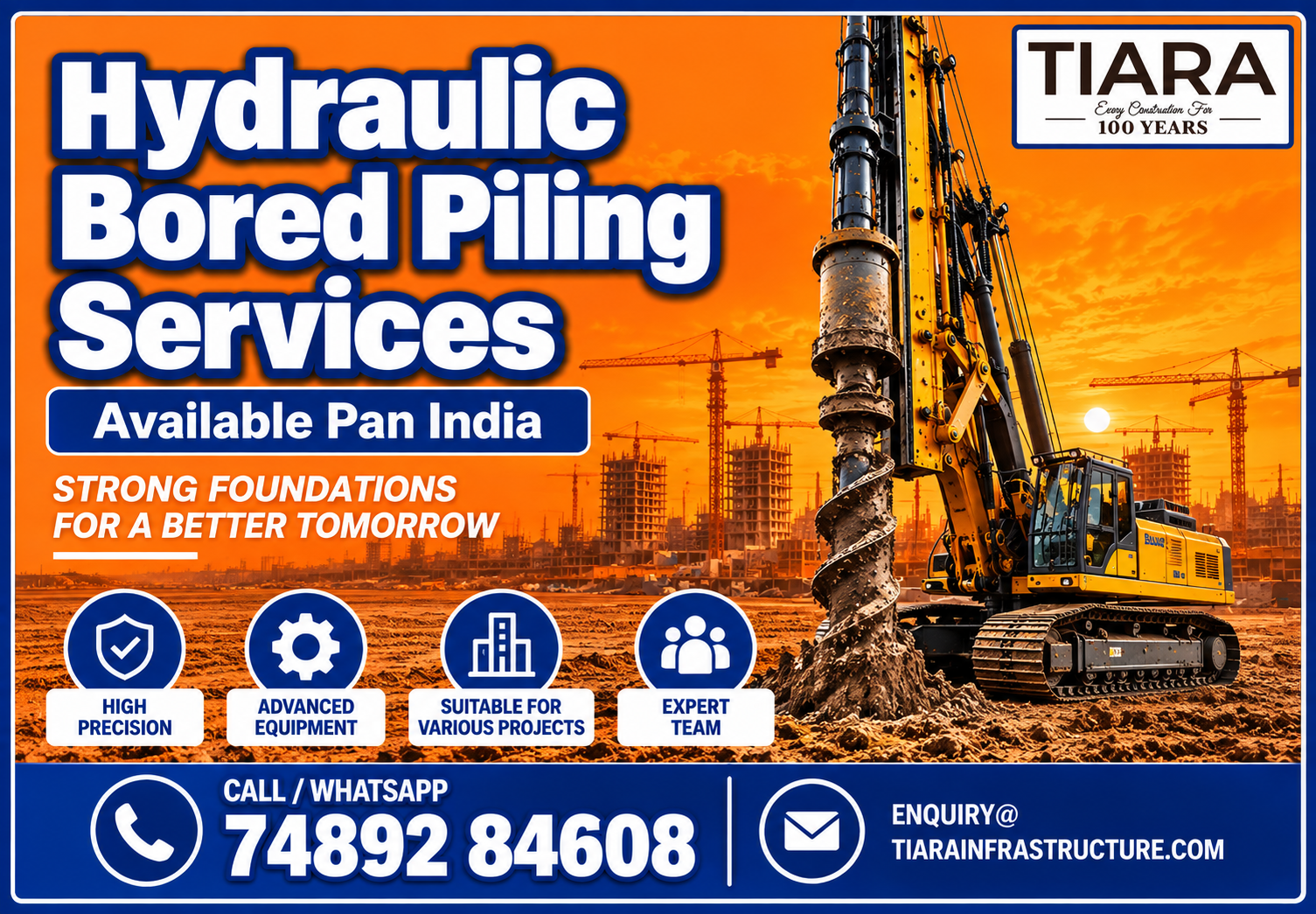
Looking for expert hydraulic bored piling contractors? Tiara Infrastructure delivers project-focused rotary bored pile foundations, cast-in-situ piling job work, reinforcement cage installation, and tremie concreting for bridges, high-rise buildings, and heavy infrastructure pan-India.
Share your site location and core technical requirements for prompt review by our foundation engineering team.
Tell us your construction, infrastructure or equipment requirement.
Hydraulic bored piling is a coordinated deep-foundation operation. Successful execution depends on the relationship between the pile design, soil profile, drilling system, bore support, reinforcement handling, concrete logistics and site access.
Available soil investigation data, pile schedule, structural drawings, founding criteria, pile diameter, depth and load requirements are reviewed before execution planning.
Hydraulic rotary piling equipment, drilling bucket, auger, core barrel or other suitable tooling is considered according to strata, pile geometry and approved methodology.
Temporary casing or an approved bore-support approach may be required where loose strata, fill or groundwater creates a risk of bore instability.
Cage fabrication, lifting, lowering, splice requirements, concrete supply and placement sequence must align with the approved pile methodology and site logistics.
The actual sequence is governed by approved drawings, geotechnical conditions, consultant requirements and the project method statement. A typical bored piling workflow can include the following stages.
Pile position, working platform and rig access are prepared and verified.
Hydraulic rotary drilling progresses using tooling suited to encountered strata.
Casing or specified stabilisation measures are applied where required.
Reinforcement cage is lifted and lowered to the specified position.
Concrete is placed using the approved procedure, with records maintained as required.
The same pile diameter does not automatically mean the same methodology. Soil layers, groundwater, obstruction risk, working platform capacity, headroom, reinforcement cage length, concrete logistics and project tolerances can materially change the execution plan.
Bored pile foundation packages for piers, abutments and related transport structures where specified by design.
Deep foundation works for towers and large developments requiring cast-in-situ bored piles.
Foundation packages for industrial structures, heavy equipment and large facilities.
Foundation works in major urban and transport projects subject to access and technical review.
Deep foundations for eligible utility and energy infrastructure according to project design.
Project-specific bored piling where structural design requires load transfer to deeper strata.
The more complete the project information, the fewer assumptions are needed during technical and commercial review.
Explore location-focused information by state and union territory. Mobilisation remains subject to project scope, technical feasibility, schedule and resource availability.
It is a cast-in-situ deep foundation method in which a bore is excavated with hydraulic rotary piling equipment, reinforcement is installed and concrete is placed according to the approved construction method.
Useful inputs include project location, pile diameter, depth, quantity, drawings, BOQ, geotechnical report, reinforcement details, access conditions, expected start date and completion period.
Geotechnical data helps the technical team understand soil strata, groundwater and likely drilling conditions. It supports equipment and methodology review but does not replace the approved project design.
Temporary casing can be considered where ground conditions or groundwater make sections of the bore unstable. The actual bore-support method must follow approved project requirements.
Project enquiries can be submitted for locations across India. Final mobilisation depends on scope, feasibility, schedule, access and resource availability.
No. Commercial requirements vary with pile quantities and geometry, location, mobilisation, strata, equipment, duration, manpower, site constraints and the agreed division of responsibilities.
Send the pile details, soil report, drawings and project location for review.

.webp)